.png)
Can Stress Cause Infertility? What the Evidence Really Says
Raghad Altoubah- Reproductive & Fertility Medical Writer


Stress is everywhere.
We experience it at work, in Relationships, with Money, with Health.
However many people in Reproductive age ask a simple but loaded question: Does stress actually cause Infertility?
➜ The short answer: Stress doesn’t directly shut down your Reproductive System! but it can disrupt it significantly enough to reduce the chances of conceiving.
➜ The long answer requires understanding the Biology, the evidence, and the limits of current research.
1) How Stress Interacts with Reproductive Hormones
Your body has two big systems relevant here:
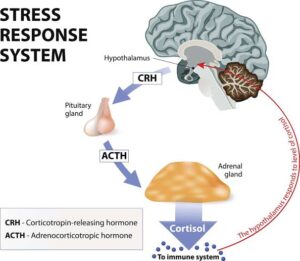
➜ The HPA axis (hypothalamus-pituitary-adrenal): It is the Neuroendocrine link between perceived stress and physiological reactions to stress
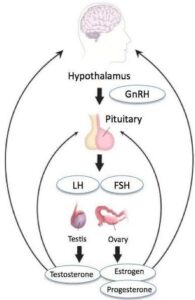
➜ The HPG axis (hypothalamus-pituitary-gonadal): the Endocrine system responsible for regulating Reproduction
Under stress: Cortisol and adrenaline rise.
These prioritize survival over reproduction.
Cortisol can:
1. Suppress GnRH (gonadotropin releasing hormone) → less LH/FSH → disrupted ovulation/sperm production.
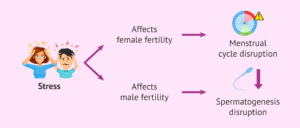
2. Disrupt menstrual cycles.
3. Affect sex drive.
That’s biologically plausible, stress hormones can interfere with Reproductive Hormones.
But Biology ≠ proof of Infertility.
2) Human Evidence: What Studies Actually Show
There’s a big difference between:
➜ Stress increasing difficulty Conceiving, and
➜ Stress directly causing Infertility as a disease.
Women
Multiple studies show:
1.Women with higher perceived stress have:
2.Irregular menstrual cycles
3.Delayed ovulation
4.Lower success in IVF
For example:
A systematic review found that stress, anxiety, and depression are higher in women with infertility, but causation isn’t proven. stress could be a result, not a cause.
Some IVF studies show higher cortisol linked with lower pregnancy rates, but effect sizes are small and inconsistent.
Men
Stress can:
1.Lower testosterone
2.Reduce sperm quality (count, motility)
3.Alter libido
But evidence is mixed: stress correlates with worse semen parameters in some studies, but not all.
Couples
Chronic stress may:
1.Increase time to pregnancy modestly
2.Reduce likelihood of conception in specific contexts
But stress alone has not been proven to be a primary cause of Infertility in Healthy couples.
Infertility is defined as:
No pregnancy after 12 months of regular, unprotected intercourse. In clinical evaluations, stress is not listed as a standalone cause. It’s considered a modifiable factor that can influence outcomes.
3) Why People Feel Stress Is the Cause
Three reasons:
✔ Infertility causes stress: Not the other way around.
Infertility itself increases anxiety, which worsens perceptions.
✔ Stress affects behavior: People under stress often ➜ Sleep poorly, Eat poorly, Consume alcohol, Miss fertility-boosting behaviors
These behaviors are real drivers of reduced fertility.
✔ Mind-body effect: Expectations, worry, and pressure around sex can reduce frequency, literally reducing opportunities to conceive.
4) What the Evidence Doesn’t Support
❌ Stress causing Infertility as a standalone disease
❌ “100% block of fertility due to stress”
❌ Stress replacing medical evaluation
5) What It Does Support (Clinically Useful)
Reducing stress can:
1. Regularize menstrual cycles
2. Improve sexual function
3. Improve lifestyle habits
4.Increase pregnancy rates modestly
In IVF populations, stress-reduction programs (mindfulness/counseling) have shown small but positive effects on outcomes.
➤ If you’re trying to conceive: Address medical causes first.
– Age, ovulation disorders, semen analysis, tubal patency.
– Treat stress as a modifier, not the root cause.
– Use high-yield lifestyle interventions: Sleep, Diet, Exercise, Reduce smoking/alcohol
– Consider structured stress reduction (CBT, mindfulness) — this helps mood and may improve outcomes.
– Talking to a clinician sooner beats blaming stress.
Stress can make conceiving harder but it’s rarely the primary driver of Infertility.
Biological plausibility is there, but causal proof in humans is weak.
Ignoring medical causes because “stress must be it” is bad strategy.
However, treating stress is valuable! Not to cure Infertility, but to improve Overall Health and possibly help fertility outcomes.