.png)
The International Status of Hamsaat Sama’a Al-Thaqafa From Cultural Work to International Institutional Presence Hamsat-Samaa-Al-Tagafa International Organization – Denmark
مخ

The International Status of Hamsaat Sama’a Al-Thaqafa
From Cultural Work to International Institutional Presence
Hamsat-Samaa-Al-Tagafa International Organization – Denmark
Introduction
The international journey of Hamsat-Samaa-Al-Tagafa reflects a gradual institutional development built over years of cultural, academic, humanitarian, and international cooperation.
From its beginnings in Denmark as a cultural association, Hamsaat expanded its activities through international conferences, academic partnerships, cultural initiatives, women’s programs, humanitarian projects, and cooperation with institutions across Europe, the Arab world, Palestine, and India.
The year 2026 represents a decisive milestone in this journey.
It is the year in which Hamsat-Samaa-Al-Tagafa entered a new stage of formal institutional engagement with the United Nations system through the granting of Special Consultative Status with the United Nations Economic and Social Council (ECOSOC).
This achievement does not replace the organization’s previous history. Rather, it provides a new institutional framework through which that accumulated experience can contribute to international civil society engagement.
First: The Institutional Transformation
Hamsaat’s international presence was not established overnight.
It developed through successive stages:
Cultural initiative
→ institutional development
→ international partnerships
→ conferences and forums
→ humanitarian projects
→ international presence
→ formal consultative status with ECOSOC.
The organization’s network gradually expanded across Palestine, Europe, the Arab world, and India.
Its partnerships with universities, cultural institutions, women’s organizations, humanitarian organizations, and international bodies created an accumulated record of international cooperation.
This experience became an important foundation for the organization’s subsequent international institutional development.
Second: A Historic Milestone in 2026
The year 2026 represents a turning point in the institutional history of Hamsat-Samaa-Al-Tagafa.
On 10 June 2026, the United Nations Economic and Social Council ECOSOC adopted the recommendation of the Committee on Non-Governmental Organizations to grant Hamsat-Samaa-Al-Tagafa Special Consultative Status.
On 23 June 2026, the United Nations formally notified the organization of the decision and conveyed its congratulations on this achievement.
The official United Nations notification constitutes the primary documentary reference for this milestone.
This development represents a significant transition from international cultural activity to formal participation within the framework of international civil society engagement.
Third: What Does Special Consultative Status Mean?
Special Consultative Status with ECOSOC is not membership in the United Nations, nor does it give an organization governmental status.
It is a formal consultative relationship between the United Nations and qualifying non-governmental organizations.
The United Nations recognizes three categories of consultative status:
- General Consultative Status
- Special Consultative Status
- Roster Status
Special Consultative Status is granted to organizations with recognized expertise in particular fields falling within the scope of ECOSOC’s work.
Accordingly, the accurate institutional designation for Hamsaat is:
Hamsat-Samaa-Al-Tagafa – Special Consultative Status with ECOSOC
This is the terminology that should be used in the organization’s official international documents and communications.
Fourth: What Does the Status Enable?
According to the United Nations framework, organizations holding consultative status may engage with:
ECOSOC,
its subsidiary bodies,
certain human rights mechanisms,
and selected United Nations meetings and processes,
subject to the applicable rules and procedures.
Depending on the specific body or process, participation may include:
- Attending meetings.
- Submitting written statements.
- Participating in relevant dialogues and events.
- Organizing side events in accordance with established procedures.
- Engaging with relevant United Nations bodies and mechanisms.
Therefore, Special Consultative Status provides Hamsaat with a formal institutional channel for international civil society participation.
It is not merely an honorary recognition.
Fifth: The Institutional and Legal Framework
The relationship between ECOSOC and non-governmental organizations with consultative status is governed principally by ECOSOC Resolution 1996/31.
The framework establishes eligibility requirements, participation rights and responsibilities, procedures for consultative status, and the role of the Committee on Non-Governmental Organizations.
The Committee reviews applications and makes recommendations, while the final decision to grant consultative status rests with ECOSOC.
Accordingly, Hamsaat’s achievement represents an institutional process involving:
review by the Committee on NGOs
→ recommendation
→ adoption by ECOSOC
→ formal notification by the United Nations.
This distinction is important when documenting the organization’s international status.
Sixth: Official United Nations Documentation
The significance of this achievement lies particularly in the fact that it is supported by official United Nations documentation.
The organization received formal notification from the United Nations dated 23 June 2026, confirming that ECOSOC had adopted the recommendation on 10 June 2026 to grant Hamsat-Samaa-Al-Tagafa Special Consultative Status.
In addition, the organization appears in the official United Nations Office at Geneva NGO List for 2026 under the name:
Hamsat-Samaa-Al-Tagafa
with:
Headquarters: Denmark
Accreditation Year: 2026
The appearance of the organization’s name in the official United Nations Geneva list provides an additional institutional confirmation of its presence within the UN civil society framework.
Seventh: Geneva and International Institutional Presence
Geneva represents an important new space in Hamsaat’s international institutional journey.
The city brings together:
the United Nations,
international organizations,
human rights mechanisms,
international civil society,
and global dialogue.
For Hamsaat, Geneva provides an opportunity to connect its accumulated cultural, academic, humanitarian, and civil society experience with a broader international institutional environment.
The organization’s presence in the United Nations Geneva framework should therefore be understood as part of a developing institutional pathway rather than as a symbolic appearance.
Eighth: UN Geneva and Civil Society Engagement
The United Nations Office at Geneva (UNOG) provides mechanisms through which accredited non-governmental organizations can engage with the United Nations and participate in relevant activities according to established procedures.
The NGO Liaison Unit serves as an important point of contact between the United Nations and civil society organizations in Geneva.
This institutional environment provides opportunities for organizations to follow relevant United Nations activities, participate in meetings where eligible, and develop appropriate forms of international engagement.
For Hamsaat, this creates a new opportunity to organize its international presence in a structured and strategic manner.
Ninth: iCSO and the Digital Institutional Framework
The Integrated Civil Society Organizations System (iCSO) is part of the United Nations’ digital infrastructure for engagement with civil society organizations.
It supports institutional interaction and administrative processes connected with NGO participation within the United Nations system.
For Hamsaat, understanding and properly managing its institutional presence through the relevant UN systems is therefore an important component of its new international phase.
The digital record is not merely administrative.
It becomes part of the organization’s formal international identity.
Tenth: From Obtaining Status to Exercising a Role
Obtaining Special Consultative Status is an achievement.
But it is not the end of the journey.
The more important stage begins afterward:
From obtaining status
to exercising a role.
The new status should therefore be connected with a clear international program reflecting Hamsaat’s accumulated areas of expertise.
This includes:
- Arabic language and culture.
- Women’s empowerment.
- Children and humanitarian action.
- Education and scientific research.
- Peace and intercultural dialogue.
- Youth and capacity building.
- Cultural diplomacy and international cooperation.
Eleventh: Arabic Language and Culture
Arabic language and culture constitute an important dimension of Hamsaat’s international identity.
Through its conferences, academic partnerships, publications, and educational initiatives, Hamsaat has developed substantial experience in promoting Arabic language and cultural dialogue.
Special Consultative Status creates an opportunity to present Arabic language and culture within broader international discussions related to:
education,
cultural diversity,
intercultural dialogue,
knowledge exchange,
and sustainable human development.
Thus, Arabic can become not only a subject of cultural activity, but also a tool for international dialogue.
Twelfth: Women and Empowerment
Women’s empowerment has been one of the distinctive themes of Hamsaat’s international activities.
Its conferences and institutional partnerships with women’s organizations in the Arab world have created an accumulated body of experience.
The partnerships with:
the UAE Businesswomen Council
and
the Iraqi Businesswomen Council
are among the institutional examples of this work.
The new international status provides an opportunity to connect this experience with wider international discussions concerning women’s participation, empowerment, education, leadership, and social development.
Thirteenth: Children and Humanitarian Action
Hamsaat’s humanitarian experience, particularly the project:
“Bringing Back Smiles to the Faces of Palestinian Children”
provides another important foundation for its international role.
The project connected Danish humanitarian initiative, Italian medical expertise, Palestinian health institutions, medical professionals, and volunteers.
This experience demonstrates that Hamsaat’s international identity extends beyond cultural activities into practical humanitarian action.
The organization’s international presence can therefore contribute to broader civil society discussions concerning:
children’s welfare,
health,
human dignity,
humanitarian cooperation,
and access to specialized care.
Fourteenth: Education and Scientific Research
Hamsaat has built a broad network of academic partnerships, particularly through its work with universities and educational institutions in Palestine, Europe, and India.
These relationships have supported:
- Academic conferences.
- Arabic language programs.
- Research.
- Training.
- Student development.
- Exchange of expertise.
- Cultural and educational initiatives.
The international status provides an opportunity to connect this accumulated academic experience with international discussions concerning education, knowledge, language, and human development.
Fifteenth: Peace and Intercultural Dialogue
Dialogue between cultures has been a recurring theme throughout Hamsaat’s international activities.
Its conferences on women and the dialogue of civilizations, its Jerusalem Cultural Caravan, its academic partnerships, and its cooperation with institutions concerned with peace and education all reflect an underlying commitment to dialogue.
This experience can contribute to international civil society initiatives aimed at:
building bridges,
promoting mutual understanding,
supporting peace education,
and strengthening dialogue among cultures.
Sixteenth: From Conferences to Civic Cultural Diplomacy
Hamsaat has accumulated extensive experience in organizing international conferences and establishing institutional partnerships.
With the acquisition of Special Consultative Status, this experience can evolve toward a broader form of:
Civic Cultural Diplomacy
This does not refer to governmental diplomacy.
Rather, it refers to the use of culture, education, dialogue, research, humanitarian action, and civil society partnerships to strengthen understanding between peoples and institutions.
In this context, Hamsaat can develop its role as:
A bridge between Arab cultural experience and international institutions.
Seventeenth: The Responsibility of International Status
International recognition creates opportunities, but it also creates responsibilities.
Among the most important are:
- Respecting the rules governing consultative status.
- Maintaining institutional transparency.
- Documenting international activities.
- Submitting required reports within the established framework.
- Ensuring that participation is connected to the organization’s areas of expertise.
- Avoiding any language that suggests the organization represents the United Nations.
- Maintaining the organization’s independent civil society identity.
The new status therefore requires a stronger internal system for documentation, planning, reporting, and institutional follow-up.
Eighteenth: The New Institutional Vision
The transformation represented by 2026 can be summarized as follows:
Before Consultative Status
International cultural organization
→ conferences
→ partnerships
→ projects
→ international presence.
After Consultative Status
International cultural organization
→ Special Consultative Status with ECOSOC
→ formal UN civil society engagement
→ international participation
→ programs and initiatives with broader institutional reach.
The new status does not replace Hamsaat’s history.
It provides a new framework through which that history can be developed and extended.
Nineteenth: Geneva as a New Chapter
Geneva represents a particularly significant stage in Hamsaat’s international journey.
It provides a meeting point between:
international institutions,
civil society,
human rights,
peace,
education,
culture,
and global dialogue.
For Hamsaat, this creates an opportunity to connect its previous experience with a new level of institutional participation.
The conference is no longer the only objective.
Rather, the conference can become:
A tool for dialogue, participation, partnership, and impact.
Twentieth: From Denmark to the United Nations
Hamsaat began its journey in Denmark and gradually developed an international network of conferences, partnerships, cultural projects, academic initiatives, and humanitarian activities across Palestine, Europe, the Arab world, and India.
The year 2026 adds a new institutional dimension:
Formal presence within the United Nations civil society framework.
The journey can therefore be read as a continuous path:
Denmark
→ cultural work
→ international partnerships
→ conferences
→ humanitarian action
→ international presence
→ Special Consultative Status with ECOSOC.
Twenty-First: The Strategic Opportunity Ahead
The granting of Special Consultative Status should be viewed as the beginning of a new institutional phase.
Hamsaat can build on this status by developing:
- A structured international participation strategy.
- An annual program of relevant UN-related engagement.
- Policy-oriented cultural initiatives.
- International forums connected to its areas of expertise.
- Research and advocacy initiatives.
- Civil society partnerships.
- Humanitarian and child-focused programs.
- International Arabic language and cultural initiatives.
- Women’s empowerment and leadership programs.
The objective should not be to participate everywhere.
It should be to participate where Hamsaat can contribute meaningfully and credibly.
Twenty-Second: The Meaning of the New Stage
The importance of 2026 is therefore not limited to obtaining a new institutional designation.
It marks the transition:
From visibility to institutional presence.
From participation to structured engagement.
From cultural activity to international civic contribution.
From partnership to wider international impact.
This is the responsibility that accompanies the new status.
Conclusion
From International Presence to International Participation
The granting of Special Consultative Status with ECOSOC to Hamsat-Samaa-Al-Tagafa in 2026 represents a major milestone in the organization’s institutional development.
The achievement is supported by official United Nations documentation dated 23 June 2026, confirming the ECOSOC decision of 10 June 2026.
The organization’s appearance under the name Hamsat-Samaa-Al-Tagafa in the official United Nations Office at Geneva NGO List for 2026, with Denmark identified as its headquarters, provides an additional confirmation of its institutional presence within the UN civil society framework.
Yet the true value of this achievement lies beyond the status itself.
The central question now is:
What will Hamsaat do with this international position?
Its history provides the answer.
It can transform status into:
participation,
participation into initiatives,
initiatives into partnerships,
and partnerships into lasting cultural, educational, and humanitarian impact.
The new chapter is therefore not simply:
From Denmark to the United Nations.
It is:
From cultural presence to institutional participation.
From participation to impact.
From impact to a sustainable humanitarian and civilizational contribution.
Hamsat-Samaa-Al-Tagafa
From Denmark to the World… From Culture to International Institutional Presence.
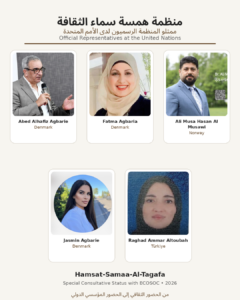
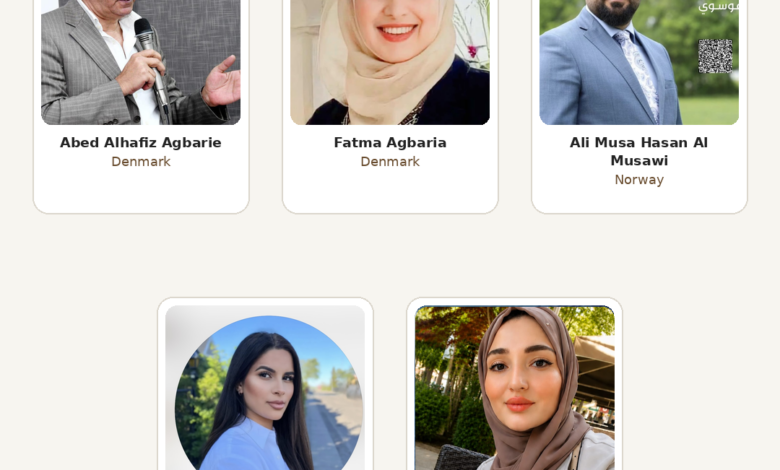
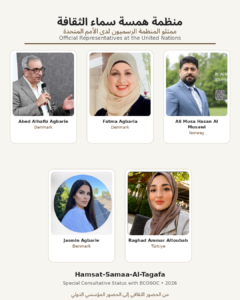
Official Representatives of Hamsat-Samaa-Al-Tagafa at the United Nations
As part of its transition from institutional recognition to active international representation and engagement, Hamsat-Samaa-Al-Tagafa International Organization – Denmark has officially appointed representatives to represent the Organization at the United Nations, in accordance with the applicable rules and procedures governing NGO participation within the United Nations system.
Current Official Representatives
Abed Alhafiz Agbarie
🇩🇰 Denmark
Fatma Agbaria
🇩🇰 Denmark
Ali Musa Hasan Al Musawi
🇳🇴 Norway
Jasmin Agbarie
🇩🇰 Denmark
Raghad Ammar Altoubah
🇹🇷 Türkiye
Two additional representatives from Denmark are expected to be officially appointed by the end of 2026.
Institutional Clarification
These representatives represent Hamsat-Samaa-Al-Tagafa at the United Nations and do not represent, speak on behalf of, or act as representatives of the United Nations.
The Organization’s Special Consultative Status with ECOSOC does not constitute membership in the United Nations, nor does it make the Organization a governmental entity. Rather, it establishes a formal consultative relationship between the Organization, as a non-governmental organization, and the United Nations Economic and Social Council, in accordance with the applicable rules and procedures.