.png)
Humanitarian and Charitable Work in the Journey of Hamsaat Sama’a Al-Thaqafa From Initiative to Impact… The Human Being First Hamsaat Sama’a Al-Thaqafa International Organization – Denmark

Humanitarian and Charitable Work in the Journey of Hamsaat Sama’a Al-Thaqafa
From Initiative to Impact… The Human Being First
Hamsaat Sama’a Al-Thaqafa International Organization – Denmark
Introduction
Humanitarian work has never been a secondary or separate activity in the journey of Hamsaat Sama’a Al-Thaqafa. Rather, it has emerged as a natural extension of its belief that genuine culture begins with the human being and that building societies cannot be complete without solidarity, care, and respect for human dignity.
From this perspective, Hamsaat has sought to transform the values of cultural and social solidarity into practical humanitarian initiatives, particularly those addressing the needs of vulnerable groups and children.
One of the most significant examples of this approach is the project:
“Bringing Back Smiles to the Faces of Palestinian Children”
The project was not based on providing temporary assistance alone. It brought together humanitarian initiative, international medical cooperation, institutional coordination, medical treatment, professional training, and the development of local capacity to follow up on patients.
The project was implemented through cooperation between Hamsaat Sama’a Al-Thaqafa International Organization – Denmark, the Italian medical humanitarian organization Emergenza Sorrisi, and the Palestinian Ministry of Health.
The humanitarian experience therefore followed a clear path:
From compassion to initiative,
from initiative to organization,
from organization to implementation,
and from implementation to lasting impact.
First: Hamsaat’s Philosophy of Humanitarian Work
Hamsaat’s humanitarian work is based on the conviction that the human being is at the heart of development and that every child deserves access to appropriate healthcare, education, and social support that protects the right to a dignified life.
For this reason, the organization does not regard humanitarian work simply as the provision of assistance. Rather, it considers it a form of human responsibility and institutional partnership.
Sustainable humanitarian work should not merely respond to a problem at a particular moment. It should also seek to:
- Reach those most in need.
- Provide specialized assistance.
- Mobilize international expertise.
- Support local professionals.
- Transfer knowledge and experience.
- Build sustainable local capacity.
- Preserve the dignity of beneficiaries.
This vision provided the foundation for Hamsaat’s international medical cooperation.
Second: “Bringing Back Smiles to the Faces of Palestinian Children”
The project “Bringing Back Smiles to the Faces of Palestinian Children” represents the central example of Hamsaat’s humanitarian work.
The project was launched in cooperation with the Italian organization Emergenza Sorrisi and the Palestinian Ministry of Health, with the aim of providing specialized medical assistance to Palestinian children requiring surgical intervention.
The cases included children with congenital conditions and problems related to cleft lip and palate, as well as cases requiring ophthalmological care.
The objective was not simply to perform operations, but to establish a medical cooperation model connecting:
international medical expertise
with Palestinian medical professionals,
institutional coordination,
and humanitarian care.
Third: The Italian Medical Partner – Emergenza Sorrisi
In March 2022, Hamsaat Sama’a Al-Thaqafa International Organization and Emergenza Sorrisi established a cooperation and understanding protocol.
Emergenza Sorrisi works in the medical and humanitarian field, with particular attention to children affected by facial deformities, burns, war-related injuries, and certain ophthalmological and pediatric conditions.
The organization also supports volunteer medical missions, surgical interventions, and the training of local doctors and nurses in order to transfer medical expertise and strengthen local capacity.
This cooperation became the foundation for the medical mission to Palestine.
The partnership brought together:
Hamsaat’s humanitarian and cultural initiative
and
Italian volunteer medical expertise.
Fourth: The Palestinian Ministry of Health
The implementation of the project was supported by institutional cooperation with the Palestinian Ministry of Health.
The Ministry facilitated the implementation of the medical mission and coordinated with Palestinian healthcare institutions.
In November 2022, the Palestinian Minister of Health, Dr. Mai Al-Kaila, received the Italian medical delegation at Palestine Medical Complex in Ramallah, in the presence of representatives of Hamsaat and Palestinian medical professionals.
The Ministry also contributed to the procedures and coordination necessary for the success of the mission.
Thus, the project brought together three principal partners:
Hamsaat
Initiative, coordination, and humanitarian action.
Emergenza Sorrisi
Medical expertise and volunteer medical teams.
Palestinian Ministry of Health
Local institutional and health coordination.
Fifth: Reaching Palestine
In November 2022, the Italian medical mission arrived in Palestine through the initiative of Hamsaat and in cooperation with the Palestinian Ministry of Health.
Hamsaat representatives received the medical delegation from Italy, after which the team proceeded to Ramallah to begin its medical work.
Although the mission was limited in duration, its impact extended beyond the team’s physical presence through patient follow-up and the development of local expertise.
The arrival of the medical delegation therefore marked an important moment in the project’s history:
A humanitarian initiative had become direct field action.
Sixth: Medical Assessment and Selection of Cases
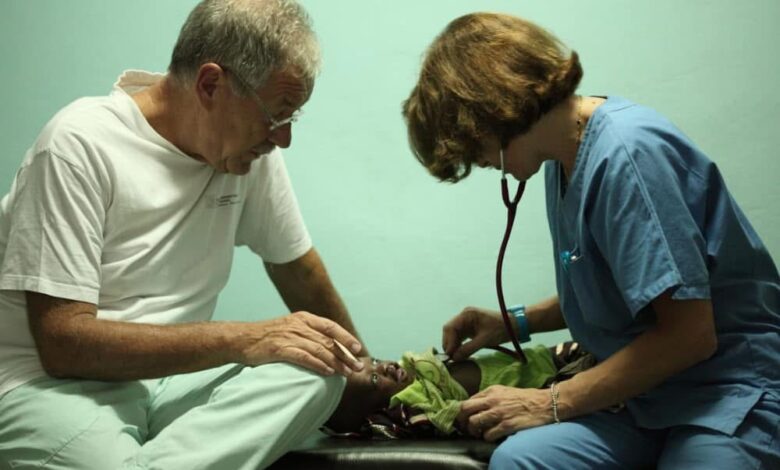
The mission began with the medical assessment of children referred to the medical complex in Ramallah.
According to the published documentation, approximately 50 children were awaiting medical evaluation, including children with cleft lip and palate and children requiring ophthalmological care.
Following examination and assessment, surgery was performed on cases considered suitable for intervention.
The first stage therefore followed a structured process:
Examination → Assessment → Case Selection → Intervention → Follow-up.
This demonstrates that the project was not an improvised charitable campaign, but a coordinated medical humanitarian initiative.
Seventh: Surgical Procedures
During the following days, surgical procedures were performed on the children.
According to the published report concerning the first mission, 38 children underwent surgical intervention following medical examination and assessment.
The procedures included operations related to cleft lip and palate and other medical conditions, in addition to ophthalmological work.
Hamsaat documented the joy of families following the procedures, emphasizing that the humanitarian objective was not merely to provide medical treatment, but to restore hope, confidence, and a smile to children and their families.
Eighth: Ophthalmological Care
The mission was not limited to cleft lip and palate surgery.
It also included ophthalmological cases, and the medical team visited the Eye Hospital in Ramallah to follow up on procedures performed by the Italian specialist in cooperation with Palestinian doctors.
This demonstrates the broader medical scope of the project and its response to several specialized healthcare needs among children.
Ninth: Training Palestinian Doctors
One of the most important dimensions of the project was that it did not stop at treating children.
The mission also included training Palestinian doctors to follow up on patients after surgery.
The philosophy of Emergenza Sorrisi combines medical intervention with professional training for local healthcare teams, helping transfer expertise and strengthen the capacity of local institutions to address similar cases in the future.
Here, humanitarian action moves from:
Treating one patient
to:
Building local capacity capable of serving many patients in the future.
This is a fundamental element of Hamsaat’s humanitarian philosophy.
Tenth: Sustainability Rather Than Temporary Assistance
One of the most important lessons of the project is that humanitarian work can have greater impact when it combines immediate assistance with sustainable capacity building.
A surgical procedure can change one child’s life immediately, while training a local doctor can contribute to the treatment of many other children in the future.
For this reason, medical intervention was accompanied by training, knowledge transfer, and follow-up.
This model represents:
Sustainable Humanitarian Action.
Eleventh: The Waiting List Reveals the Scale of Need
Following the initial stages of the mission, the number of children on the waiting list reached approximately 250, according to the published project report.
This revealed the scale of the need for specialized medical care and demonstrated the importance of continuing the work rather than limiting it to a single mission.
This was one of the factors behind the continuation and renewal of the cooperation.
Twelfth: Renewal of Cooperation in 2023
In March 2023, the cooperation agreement was renewed for the second time between Hamsaat Sama’a Al-Thaqafa International Organization and Emergenza Sorrisi to continue the project “Bringing Back Smiles to the Faces of Palestinian Children.”
The renewal followed the results achieved by the project and the volunteer work undertaken by the participating organizations.
The renewed cooperation also continued coordination with the Palestinian Ministry of Health, which provided the necessary support and facilitation.
Thus, the project evolved from:
an initial initiative → to a successful experience → to renewed cooperation.
Thirteenth: Media Coverage and Documentation of Impact
The project received attention beyond Hamsaat’s own documentation.
Italian media also covered the initiative, including a television report on the medical work at the Ramallah government hospital, documenting the cooperation between Hamsaat, Emergenza Sorrisi, and the Palestinian Ministry of Health.
This demonstrated that the project had moved beyond the internal activities of one organization and had become an example of cross-border medical and humanitarian cooperation.
Fourteenth: The Human Being Before the Institution
One of the most important characteristics of the project was that the participating institutions were not the central focus.
The child was the center of the work.
The organization, medical foundation, ministry, doctors, nurses, and volunteers all came together around one objective:
To give the child a better chance at life.
That is the true value of humanitarian action.
Fifteenth: Psychological and Social Impact
The success of the project cannot be measured only by the number of surgical procedures.
For a child, medical intervention can mean:
- Restoring self-confidence.
- Reducing feelings of difference and isolation.
- Improving social integration.
- Reducing the psychological burden on the family.
- Creating better opportunities for education, participation, and a dignified life.
Hamsaat documented the emotions and joy of families following the procedures, reflecting the deeper humanitarian dimension of the project.
Sixteenth: A Network of Humanitarian Solidarity
The project demonstrated that successful humanitarian work requires a network of institutions, professionals, volunteers, and coordinators.
The initiative brought together:
A cultural international organization from Denmark,
an Italian volunteer medical organization,
the Palestinian Ministry of Health,
Palestinian doctors,
Italian doctors and nurses,
and volunteers and coordinators.
This network made the implementation of the project possible.
Seventeenth: From Palestine to a Global Concept of Solidarity
The project carries a message that extends beyond Palestine.
It offers a practical example of what international cooperation can accomplish when the human being is placed at the center.
Institutions may differ in their geographical location and organizational role, but human suffering knows no borders, and neither does solidarity.
The project therefore became a practical expression of:
Cross-Border Humanitarian Solidarity.
Eighteenth: Humanitarian Work as Part of Hamsaat’s Identity
Humanitarian work cannot be separated from Hamsaat’s cultural identity.
For Hamsaat, culture is not limited to literature, art, and conferences. It also encompasses:
values, responsibility, solidarity, and respect for human dignity.
The medical humanitarian project therefore became part of the organization’s broader mission:
Building people and serving communities.
Nineteenth: Lessons Learned
The experience of “Bringing Back Smiles to the Faces of Palestinian Children” provides several important lessons.
First
Humanitarian initiatives require an institution capable of coordination.
Second
International specialization can help address local gaps in expertise.
Third
Training makes humanitarian assistance more sustainable.
Fourth
Institutional partnerships multiply impact.
Fifth
Children must remain at the center of humanitarian work.
Sixth
True success is measured by the continuation of impact after the mission ends.
Twentieth: The Hamsaat Model for Humanitarian Action
The experience allows us to formulate a practical model for humanitarian work within Hamsaat:
Initiative
Identifying the humanitarian need.
⬇️
Partnership
Mobilizing the appropriate institutions and expertise.
⬇️
Coordination
Connecting international expertise with local institutions.
⬇️
Implementation
Providing direct humanitarian services.
⬇️
Training
Transferring knowledge and expertise to local professionals.
⬇️
Follow-up
Ensuring continuity of care.
⬇️
Impact
Transforming assistance into meaningful change in people’s lives.
This model moves beyond the concept of a temporary charitable campaign toward institutional humanitarian action.
Twenty-First: Hamsaat’s Future Humanitarian Vision
The experience of “Bringing Back Smiles to the Faces of Palestinian Children” opens broader possibilities for the future development of Hamsaat’s humanitarian work through:
- Expanding medical partnerships.
- Supporting children with specialized healthcare needs.
- Developing training programs for local professionals.
- Strengthening cooperation between European and Arab institutions.
- Connecting humanitarian action with scientific research.
- Developing sustainable projects rather than temporary initiatives.
- Systematically documenting the impact of humanitarian programs.
This vision is based on one fundamental principle:
The best humanitarian work is work that creates the capacity to continue.
Conclusion
From Initiative to Impact… The Human Being First
Hamsaat’s humanitarian experience demonstrates that culture can become action, solidarity can become a project, and partnership can restore hope and change lives.
The project:
“Bringing Back Smiles to the Faces of Palestinian Children”
stands as one of the most significant examples of this journey because it brought together a Danish humanitarian initiative, Italian medical expertise, Palestinian health coordination, volunteer action, professional training, and knowledge transfer.
The objective was not simply to perform surgical procedures.
The deeper objective was to help children regain confidence, give families renewed hope, and transform international medical expertise into sustainable local capacity.
Therefore, the most meaningful measure of the project is not the number of institutions involved or the number of days of the medical mission.
It is this:
A child smiled.
And from that smile, Hamsaat’s humanitarian message expands:
We help people… we protect their dignity… and we create lasting impact.
Hamsaat Sama’a Al-Thaqafa
From Initiative to Impact… The Human Being First.