.png)
The Jerusalem Cultural Caravan From Jerusalem to the World: Culture as a Bridge for Dialogue, Peace, and Identity Hamsa Sama Al-Thaqafa International Organization – Denmark

Introduction
The “Jerusalem Cultural Caravan” is one of the major international cultural projects launched by Hamsa Sama Al-Thaqafa International Organization.
It was conceived not as a single conference, but as a continuing cultural project carrying the message of Jerusalem from its geographical and historical setting into wider international spaces of cultural and civilizational dialogue.
The Caravan was launched from Jerusalem in 2018, then travelled to Amman, followed by Tunis, moved into the digital sphere through Hamsa Net, and later returned to direct international engagement in Bucharest, Romania, in 2025. (همسة سماء الثقافة لتنمية المرأة والطفل)
Through this journey, the Caravan became an important part of the institutional history of Hamsa and reflected its belief that culture can serve as a bridge for communication, while Jerusalem is not merely a geographical or political issue, but also a historical, cultural, human, and civilizational one.
1. The Idea and Mission of the Caravan
Hamsa Sama Al-Thaqafa International Organization gave its international cultural initiative the name:
“The Jerusalem Cultural Caravan”
The concept was to carry a message of love, peace, justice, and equality, while highlighting Jerusalem as a city of historical, cultural, and civilizational significance.
The Organization also sought to create opportunities for research, cooperation, and the exchange of expertise in cultural, historical, and developmental fields. (همسة سماء الثقافة لتنمية المرأة والطفل)
The Caravan was therefore intended to become a continuing cultural journey, with Jerusalem as its point of departure and international dialogue as its wider destination.
2. Jerusalem – The First Point of Departure, 2018
The Jerusalem Cultural Caravan was launched from Jerusalem in May 2018.
Its first conference was held at Al-Quds University, under the patronage of President Mahmoud Abbas and in cooperation with Al-Quds University and the Dr. Adnan Majli Educational Foundation. (همسة سماء الثقافة لتنمية المرأة والطفل)
This was the foundational moment of the project.
The Caravan began in the city whose name it carries and then embarked on an international journey designed to introduce Jerusalem through culture, history, education, heritage, and dialogue.
3. Why Jerusalem?
Jerusalem was deliberately chosen as the starting point because of its unique place at the intersection of civilizations, cultures, religions, history, and collective memory.
Within the vision of Hamsa, Jerusalem is not simply a city. It represents a cultural and historical space deeply connected to:
- Heritage.
- Language.
- Literature.
- Education.
- Religious and cultural landmarks.
- Collective memory.
- Identity.
- Civilizational dialogue.
The Caravan therefore sought to present Jerusalem through cultural and intellectual engagement and to strengthen awareness of its historical and cultural identity.
4. From Jerusalem to Amman – 2018
After its launch in Jerusalem, the Caravan continued to the Jordanian capital, Amman.
The second conference was held in October 2018, under the honorary patronage of His Royal Highness Prince Hassan bin Talal, with broad international participation. Hamsa’s historical documentation later referred to participation from more than 30 Arab and European countries. (همسة سماء الثقافة لتنمية المرأة والطفل)
The Organization’s archive documents the second Jerusalem Conference in Amman on 22 October 2018. (همسة سماء الثقافة لتنمية المرأة والطفل)
Amman thus became the first major international destination of the Caravan after Jerusalem.
5. From Jerusalem to a Wider Dialogue
The movement from Jerusalem to Amman was not merely geographical.
The Caravan carried with it the cultural message with which it had begun in Jerusalem and opened a broader space for Arab and international dialogue concerning Jerusalem and its cultural and historical dimensions.
The journey began to develop into a clear sequence:
Jerusalem – the point of departure.
Amman – expansion of the dialogue.
Tunis – entry into a wider Arab cultural and institutional space.
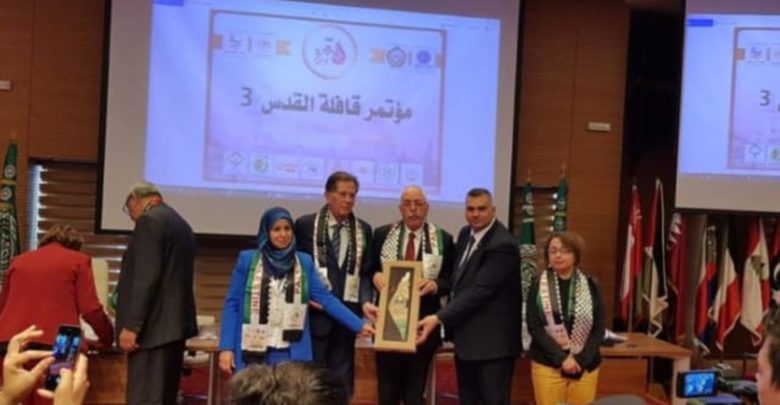
6. The Third Edition – Tunis, 2019
In early 2019, the Caravan continued its journey to Tunis, Tunisia.
Its third conference was held at the headquarters of the Arab League Educational, Cultural and Scientific Organization (ALECSO).
The conference was organized in cooperation with the Rehab Family and Child Association of Tunisia, with the participation of the Embassy of the State of Palestine in Tunis and under the supervision of the Arab League’s Tunis office. (همسة سماء الثقافة لتنمية المرأة والطفل)
The conference addressed Jerusalem through a broad cultural perspective, including:
Social, Cultural, Humanitarian, and Heritage Transformations
The Tunis edition connected the Jerusalem issue with cultural heritage, social development, identity, and broader Arab cultural concerns.
7. Jerusalem within the ALECSO Cultural Space
Holding the third edition at ALECSO carried important institutional and cultural significance.
The Caravan had moved from the city of Jerusalem into a major Arab cultural and educational institution.
Jerusalem therefore became part of a wider institutional discussion involving:
- Heritage.
- Education.
- Culture.
- Language.
- Identity.
- History.
- Development.
This expanded the scope of the Caravan beyond a local or national framework.
8. Hamsa’s Leadership in Tunis
Dr. Fatma Abu Wasel Agbaria, President of Hamsa Sama Al-Thaqafa International Organization, delivered the opening address of the Tunis conference.
Her participation reflected the Organization’s direct leadership of the project and its commitment to maintaining the Caravan as an international initiative rather than a series of unrelated local events.
The Organization’s archive also documents the arrival of its leadership in Tunis for the third edition. (همسة سماء الثقافة لتنمية المرأة والطفل)
9. The Caravan as a Partnership-Based Project
From its first edition, the Jerusalem Cultural Caravan relied on partnerships with academic, cultural, governmental, diplomatic, and civil society institutions.
Among the institutions connected with its documented journey were:
- Al-Quds University.
- The Dr. Adnan Majli Educational Foundation.
- Hamsa Sama Al-Thaqafa International Organization.
- The Embassy of the State of Palestine.
- The Arab League.
- ALECSO.
- The Rehab Family and Child Association in Tunisia.
- Academic, cultural, media, and civil society figures.
The Caravan therefore developed as a partnership-based cultural initiative.
10. The Caravan and Cultural Dialogue
One of the project’s central objectives was to transform discussion of Jerusalem into a broader international cultural dialogue.
Its conferences brought together people from different fields, including:
- Academia.
- Culture.
- Media.
- Law.
- Education.
- Environment.
- Civil society.
- Diplomacy.
This diversity allowed Jerusalem to be examined from multiple intellectual and social perspectives.
11. The Fourth Edition – Moving into the Digital Sphere
The global circumstances created by the COVID-19 pandemic brought new challenges to international cultural events.
Hamsa responded by moving the Caravan into the digital sphere.
On 30 May 2021, the Organization held the fourth edition of the Jerusalem Cultural Caravan through its international platform, Hamsa Net.
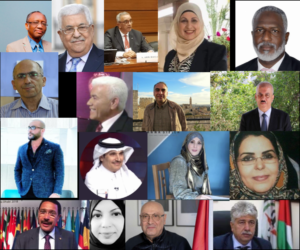
The conference was held under the patronage of President Mahmoud Abbas and lasted more than three hours, bringing together academics, diplomats, researchers, and international cultural figures. (همسة سماء الثقافة لتنمية المرأة والطفل)
This edition demonstrated that the Caravan could continue even when international travel and physical gatherings were severely restricted.
12. The Caravan’s Journey Revisited
The fourth conference opened with a presentation reviewing the Caravan’s journey since its launch in 2018.
The historical sequence was reaffirmed:
Jerusalem, 2018
Amman, 2018
Tunis, 2019
Hamsa Net, 2021 (
همسة سماء الثقافة لتنمية المرأة والطفل
)
The fourth edition therefore represented a continuation of an established international project rather than a new beginning.
13. Jerusalem and Its Legal Status
The fourth conference addressed several issues related to Jerusalem, including the city’s legal status and the situation of Palestinian territories.
Professor Manuel Hassassian, Ambassador of the State of Palestine to Denmark, addressed Jerusalem, its legal status, education, and the diplomatic work connected with the Palestinian issue. (همسة سماء الثقافة لتنمية المرأة والطفل)
Professor Hanna Issa, a legal researcher and university professor, also addressed the legal status of Jerusalem and the Palestinian territories in the context of international law. (همسة سماء الثقافة لتنمية المرأة والطفل)
14. Jerusalem and Environmental Justice
The fourth edition expanded the discussion to include environmental issues.
Professor Mazen Qumsiyeh presented a paper on:
“Environmental Justice in Palestine and Resistance through Environmental Action”
This broadened the Caravan’s understanding of Jerusalem and Palestine by connecting land, environment, identity, human rights, and sustainable development. (همسة سماء الثقافة لتنمية المرأة والطفل)
15. Jerusalem in the Arab Collective Consciousness
The fourth edition also examined the place of Palestine and Jerusalem in the wider Arab consciousness.
Saudi media figure Dr. Ahmed Al-Shahri addressed the issue of:
“The Palestinian Cause in the Arab Consciousness and the Impact of External Polarization”
This reflected the Caravan’s broader objective of examining Jerusalem not only as a Palestinian issue, but also as part of the cultural and historical consciousness of the Arab world. (همسة سماء الثقافة لتنمية المرأة والطفل)
16. Education and Cultural Identity
Education in Jerusalem was another important theme.
The conference addressed questions concerning education, curricula, cultural identity, and the challenges facing Palestinians in Jerusalem.
This dimension reflects a central principle of the Caravan:
Protecting culture begins with protecting education, language, knowledge, and collective memory.
Cultural identity cannot be preserved through rhetoric alone. It requires schools, books, language, education, historical awareness, and cultural institutions.
17. International Participation
The fourth edition brought together participants from different countries and professional backgrounds.
Among the figures documented in the Organization’s archive were:
- Professor Manuel Hassassian.
- Professor Hanna Issa.
- Professor Mazen Qumsiyeh.
- Dr. Ahmed Al-Shahri.
- Dr. Tarek Kurdi.
- Professor Ibrahim Al-Bani.
- Ms. Safaa Abdul Aziz.
- Other academic, cultural, media, and international figures.
The conference also included Palestinian Minister of Social Development Dr. Ahmed Majdalani. (همسة سماء الثقافة لتنمية المرأة والطفل)
This diversity strengthened the Caravan as a platform for interdisciplinary and intercultural dialogue.
18. From Conference to Digital Platform
The fourth edition demonstrated Hamsa’s ability to use digital media to preserve international cultural projects.
Through Hamsa Net, participants from different countries could meet without travelling.
The transition to the digital sphere was initially a response to global circumstances, but it also created a new opportunity for the Caravan to reach wider audiences.
The project consequently became capable of operating through two complementary forms:
Direct international engagement
and
Digital dialogue.
19. Preparations for a Baghdad Edition
Following the fourth edition, Hamsa continued exploring possible new destinations for the Caravan.
One of these was Baghdad.
In November 2022, the Organization documented a meeting in Baghdad involving media figure Quds Al-Samarrai and Palestine’s Ambassador to Iraq, Ahmed Aql, to discuss the possibility of holding a Jerusalem Cultural Caravan conference in Baghdad in 2023.
Dr. Fatma Abu Wasel Agbaria, President of Hamsa, also participated by telephone in discussions concerning the potential conference and possible participating universities, countries, and personalities. (همسة سماء الثقافة لتنمية المرأة والطفل)
However, the available documentation establishes preparatory efforts, not a completed edition.
Therefore, Baghdad is recorded here as:
A planned and prepared destination – not a confirmed conference edition.
This distinction preserves the historical accuracy of the institutional record.
20. The Fifth Edition – Bucharest, 2025
The Caravan continued its international journey and reached Bucharest, Romania.
Hamsa Sama Al-Thaqafa International Organization announced the fifth edition of the Jerusalem Cultural Caravan in the Romanian capital.
The fifth edition was scheduled for:
10–11 May 2025
at the Grand Venetia Hotel in Bucharest, with high-level international participation. (همسة سماء الثقافة لتنمية المرأة والطفل)
This edition represented a return to direct international engagement after the digital phase.
21. Bucharest – Continuing the Mission
Bucharest was not the beginning of a new project.
It was a new destination within the continuing journey of the:
“Jerusalem Cultural Caravan”
The name remained constant while the cities, circumstances, and methods changed.
This demonstrates a central principle:
Jerusalem remains constant in the mission, while the destinations change along the journey.
Each city hosting the Caravan becomes a new space for discussing Jerusalem’s culture, history, heritage, identity, and place within international dialogue.
22. The Cultural Dimension of the Caravan
The history of the Caravan demonstrates that culture has always remained at the center of the project.
Its conferences have addressed:
- History.
- Heritage.
- Language.
- Education.
- Literature.
- Identity.
- Law.
- Environment.
- Development.
- Media.
- Intercultural dialogue.
This diversity reflects a broad understanding of culture as a comprehensive way of life rather than simply an artistic or literary activity.
23. The Caravan and Palestinian Cultural Identity
Jerusalem occupies a central position within Palestinian cultural identity.
For this reason, the Caravan has consistently highlighted:
- Jerusalem’s history.
- Its heritage.
- Its Arab cultural identity.
- Its traditions.
- Its religious and cultural landmarks.
- Its educational life.
- Its place in Palestinian and Arab consciousness.
The project therefore contributes to the broader cultural effort to preserve memory and transmit it to future generations.
24. The Caravan as a Bridge between Palestine and the World
The Caravan is consistent with Hamsa’s wider vision of building bridges between diaspora communities and their countries and cultures of origin.
From its base in Denmark, the Organization carried the Jerusalem project to different cities and connected participants in Palestine, the Arab world, and Europe.
The Caravan thus became a meeting point between:
Local and international,
cultural and humanitarian,
historical and contemporary,
Palestinian and global.
25. The Humanitarian Dimension
Although Jerusalem remains the central focus of the project, the Caravan’s message has also embraced universal human values.
Among these are:
Love
Peace
Justice
Equality
Dialogue
Human dignity
Cooperation
Social responsibility
These values give the project a dimension that extends beyond geographical and political boundaries.
26. The Role of Hamsa Sama Al-Thaqafa International Organization
Hamsa has played the central role in:
- Launching the project.
- Organizing its conferences.
- Building partnerships.
- Communicating with institutions.
- Inviting participants.
- Managing events.
- Providing media platforms.
- Maintaining continuity.
- Moving the project into the digital sphere when necessary.
- Returning the Caravan to international in-person engagement.
The Caravan therefore represents one of the projects that demonstrate the Organization’s capacity for continuity, adaptation, and international expansion.
27. The Historical Timeline
The documented journey of the Jerusalem Cultural Caravan can be summarized as follows:
2018 – Jerusalem
Launch of the project at Al-Quds University in May, under the patronage of President Mahmoud Abbas and in cooperation with Al-Quds University and the Dr. Adnan Majli Educational Foundation. (همسة سماء الثقافة لتنمية المرأة والطفل)
2018 – Amman
Second edition in Amman in October 2018, under the honorary patronage of Prince Hassan bin Talal, with broad international participation. (همسة سماء الثقافة لتنمية المرأة والطفل)
2019 – Tunis
Third edition at ALECSO, in cooperation with the Rehab Family and Child Association, with the participation of the Palestinian Embassy and under the supervision of the Arab League’s Tunis office. (همسة سماء الثقافة لتنمية المرأة والطفل)
2021 – Hamsa Net
Fourth edition through Hamsa Net, under the patronage of President Mahmoud Abbas, with academic, diplomatic, cultural, and international participation. (همسة سماء الثقافة لتنمية المرأة والطفل)
2022–2023 – Baghdad
Preparatory efforts to explore a Baghdad edition. It is not recorded as a completed edition because the available documentation does not establish that the conference actually took place. (همسة سماء الثقافة لتنمية المرأة والطفل)
2025 – Bucharest
Fifth edition in Bucharest, Romania, on 10–11 May 2025. (همسة سماء الثقافة لتنمية المرأة والطفل)
28. What Makes the Jerusalem Cultural Caravan Distinctive?
The project can be characterized through five central features:
First: Its Point of Departure
The Caravan began in Jerusalem itself, rather than in another Arab or European capital.
Second: Continuity
It developed through five documented editions despite major international challenges.
Third: International Reach
It travelled between Palestine, Jordan, Tunisia, the digital sphere, and Romania.
Fourth: Diversity
It brought together academics, intellectuals, media professionals, diplomats, researchers, and civil society figures.
Fifth: Adaptability
It moved from direct conferences to digital engagement and later returned to international in-person activity.
29. The Caravan Is More Than a Conference
It would be inaccurate to reduce the Jerusalem Cultural Caravan to the conferences it organized.
The conference is a station.
The Caravan is the continuing project.
Its essence can therefore be represented as:
Jerusalem + Culture + Dialogue + Knowledge + Partnership + International Engagement = The Jerusalem Cultural Caravan
The name “Caravan” reflects movement: a project travelling from one place to another while carrying a consistent message and creating new spaces for cultural dialogue.
30. Jerusalem Travels to the World
From its beginning, Hamsa chose Jerusalem as the point of departure.
But the intention was never to keep Jerusalem confined within its geographical boundaries.
The Caravan carried:
Jerusalem’s memory,
its culture,
its history,
its language,
its heritage,
its humanitarian dimension,
and its message of dialogue and peace.
It travelled from Jerusalem to Amman, then Tunis, into the digital sphere, and later to Bucharest.
The cities that hosted the Caravan therefore became part of Jerusalem’s wider cultural journey.
Conclusion
From Jerusalem to the World
Over the years, the Jerusalem Cultural Caravan developed from an initiative launched by Hamsa Sama Al-Thaqafa International Organization into a continuing international cultural project.
The Caravan began in Jerusalem in 2018, at Al-Quds University, and travelled to Amman, then Tunis, where ALECSO hosted its third edition. It continued through Hamsa Net in its fourth edition and returned to direct international engagement in Bucharest in 2025. (همسة سماء الثقافة لتنمية المرأة والطفل)
At every stage, the Caravan carried the same fundamental message:
Jerusalem is not merely a place; it is memory, culture, identity, history, and civilization.
Discussing Jerusalem can therefore become an opportunity for dialogue, research, cooperation, cultural exchange, and mutual understanding among peoples.
Hamsa chose culture as a pathway to the world, dialogue as a means of bringing people closer, and knowledge as a tool for preserving memory.
The Jerusalem Cultural Caravan does not merely move a conference from one city to another.
It carries the cultural message of Jerusalem wherever it travels.
Its journey began in Jerusalem, but its message extends beyond its geographical boundaries.
Jerusalem is the point of departure.
Culture is the Caravan.
Dialogue is the road.
The world is the space of the message.
The Jerusalem Cultural Caravan therefore remains one of the projects that embodies Hamsa Sama Al-Thaqafa International Organization’s vision of building bridges among peoples and cultures, making culture a space for dialogue, peace, justice, and equality, and keeping Jerusalem present in Arab and international cultural consciousness.
From Jerusalem to the World… Hamsa carries the message of culture, and dialogue carries the voice of Jerusalem.