.png)

FERTILITY HEALTH SERIES
Egg Freezing:
Realistic Expectations for Men and Women
Evidence-Based Guide | Reproductive Health NGO
Imagine you are 32 years old. You have worked hard, built a career you are proud of, and maybe you have not found the right partner yet, or perhaps you have, but the timing simply is not right. You know you want children someday. But someday feels uncertain, and your biological clock feels very, very real.
That is exactly where millions of people find themselves today. And egg freezing, technically called Oocyte Cryopreservation has emerged as one of the most exciting tools Reproductive medicine has to offer. But alongside the excitement comes a flood of marketing, misinformation, and unrealistic promises.
This guide is here to give you the truth: what egg freezing can do, what it cannot, and what you genuinely need to know before making one of the most personal decisions of your life.

➤ What Is Egg Freezing, And How Does It Actually Work?
Egg freezing is a medical process that pauses time for your eggs.
Here is the straightforward science:
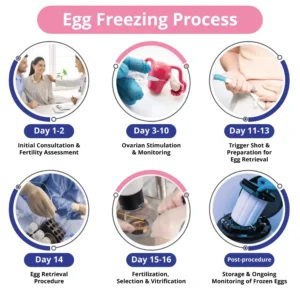
- Hormonal injections stimulate your ovaries to produce multiple eggs in a single cycle (a process called ovarian stimulation), typically over 10–14 days.
- A minor procedure called egg retrieval is performed under light sedation. A thin needle guided by ultrasound gently collects the mature eggs from your ovaries.
- The eggs are then flash-frozen using a cutting-edge technique called vitrification, cooling eggs so rapidly that damaging ice crystals cannot form.
- Your frozen eggs are stored in liquid nitrogen at -196°C, where they can remain viable for years! sometimes more than a decade.
When you are ready to use them, the eggs are thawed, fertilized with sperm in a laboratory, and the resulting embryo is transferred to your uterus. Simple in concept, but a sophisticated science in practice.
➤ The Numbers You Need to Know
➜ Egg Survival After Thawing
With modern vitrification, approximately 80–90% of frozen eggs survive the thawing process. This is a remarkable improvement over older slow-freeze methods, which had survival rates of only 50–60%.
➜ Fertilization Rates
Of the eggs that survive thawing, approximately 70–80% will fertilize successfully when inseminated with sperm.
➜ Live Birth Rates: The Most Important Number
This is where expectations need careful calibration. Live birth rates depend heavily on three key factors:
Source: American Society for Reproductive Medicine (ASRM) and Society for Assisted Reproductive Technology (SART) data, 2023.
➤ How Many Eggs Do You Actually Need?
This is the question every patient asks, and the answer is honest: it depends. But research gives us useful benchmarks.
➜ For women under 35: 10–15 mature eggs are typically recommended to give a reasonable chance of at least one live birth.
➜ For women 35–37: 15–20 eggs are recommended to achieve similar odds.
➜ For women over 38: 20+ eggs may be needed, and multiple retrieval cycles are often advised.
Here is the catch: most people do not retrieve 15–20 eggs in a single cycle. The average retrieval yields 8–15 eggs, of which only a fraction will be mature enough to freeze. This means many people require two or even three retrieval cycles to bank enough eggs, which means more time, more medication, and more cost.
➤ Who Is Egg Freezing For?
Egg freezing was once considered “experimental” by the medical establishment. That label was removed by the ASRM in 2012. Today, it is a well-established, medically recognized option for a wide range of people.
It May Be Right for You If…
- You are in your 20s or 30s and not ready to have children now but want to preserve the option.
- You have been diagnosed with cancer or another medical condition requiring treatments (like chemotherapy) that may damage your fertility.
- You have a family history of early menopause or diminished ovarian reserve.
- You are pursuing a gender transition and want to preserve fertility before hormone therapy.
- You have not yet found the right partner and do not want your reproductive window to determine your relationship timeline.
★ A Note for Men
While egg freezing is specifically for people with ovaries, male partners, donors, and men facing fertility-threatening medical treatments also have options, sperm freezing (sperm cryopreservation) is a simpler, less invasive, and lower-cost procedure. If you are facing chemotherapy, radiation to the pelvic area, or certain surgeries, sperm banking before treatment is strongly recommended. It takes one appointment and 30 minutes. There is no reason not to.
➤ The Process: What to Realistically Expect
Before You Begin: The Consultation
Your journey starts with a fertility assessment, including bloodwork to measure your ovarian reserve (primarily AMH — anti-Müllerian hormone — and FSH levels), and a transvaginal ultrasound to count your antral follicles. These tests tell your doctor how many eggs your ovaries are likely to produce in response to stimulation. They do not predict the future, but they are your most important starting data.
➜ The Stimulation Phase (10–14 Days)
You will self-administer daily hormone injections (yes, you do them yourself and most people say it becomes routine quickly). These stimulate your ovaries to mature multiple eggs simultaneously. You will visit the clinic every 2–3 days for monitoring via bloodwork and ultrasound.
Side effects during this phase can include bloating, mood changes, pelvic pressure, and fatigue. Most are manageable. A small percentage of people (around 1–2%) develop ovarian hyperstimulation syndrome (OHSS), a more serious condition that is closely monitored for and, in most cases, resolved with rest and fluids.
➜ Egg Retrieval Day
This is a 20–30 minute outpatient procedure performed under light sedation, you will not feel it. A thin needle guided by ultrasound retrieves the eggs from your follicles. You will need someone to drive you home and most people return to normal activities within 24–48 hours.
➜ After Retrieval
The embryology lab assesses how many eggs are mature and suitable for freezing. You will receive this number within 24 hours and it is not always what people hope for. Managing this emotionally is part of the process. Some cycles yield 12 mature eggs; others yield 4. This is normal variation, not failure.
➤ The Emotional Side of Egg Freezing
This part is not discussed enough. Egg freezing is a physically and emotionally demanding process. Hormonal injections can affect your mood. The wait for results, how many eggs were retrieved, how many were mature can be anxiety-inducing. And carrying the hope that these eggs represent adds a psychological weight that deserves acknowledgment.
It is okay to feel grief if a cycle does not go as hoped. It is okay to feel uncertain about whether you made the right choice. And it is okay to feel relief, excitement, and empowerment too.
➤ What Egg Freezing Cannot Do
- It does not stop your biological clock, it creates a snapshot of your fertility at the moment of freezing.
- It does not guarantee a baby. Even with 15 frozen eggs and a skilled clinic, outcomes are never certain.
- It does not prevent miscarriage. Miscarriage rates with frozen eggs are comparable to those with fresh eggs.
- It cannot reverse the effects of uterine conditions like endometriosis, fibroids, or polyps that may affect implantation.
- It does not eliminate the psychological, physical, and financial challenges of IVF, which you will still need to undergo when you use your eggs.
Understanding these limits is not meant to discourage you! it is meant to protect you from making decisions based on false promises. The best outcomes come from clear-eyed hope, not wishful thinking.
This article was written for educational and informational purposes only. It does not constitute medical advice. Please consult a qualified reproductive specialist for guidance tailored to your individual health needs.